The Road Before Me
GREECE, TURKEY, INDIA (MPI) — The Roman poet Horace once said: “Those who go overseas find a change of climate, not a change of soul.” I believe he meant that though the world outside the traveler is different, the traveler himself remains the same. While I generally agree that a person cannot escape his own fundamental character, my experience on the road suggests an addendum to the poet’s remark. The different landscapes and cultures, the different ways of seeing and being in the world that one encounters through extensive traveling can be a transformative experience, helping a person to understand himself better and to see that despite their many differences all human beings share a common experience, the experience of being human.
Many years ago, having finished college and beset with a profound wanderlust, I determined that it was not yet the time to settle down. I took a job for a couple of years in order to stash away some money for my vaguely planned adventure, and once the sum seemed reasonably sufficient to make a start, I left my home in the United States with her greatest poet’s words ringing in my ears:
Healthy, free, the world before me,
The long brown path before me leading wherever I choose.
It took a while before I reached a long brown path, as I needed to fly across the Atlantic Ocean, but eventually, after spending some months in Europe, I began my Journey to the East.
That was fifty years ago. The world was different then. When I see photos of hundreds of climbers stretched out in a line on their way to the summit of Mt. Everest, I can only shake my head and count my blessings, for back in the middle 1970s when I trekked, on two separate occasions, to the old Everest Base Camp at Gorak Shep, one could walk for days meeting only the local people moving along the trails in that world of incomparable beauty, the Himalaya. I never attempted to reach the summit, happy to enjoy the lower valleys and the spectacular scenery of the Khumbu region. That I never wanted to climb the famous mountain itself speaks to not only an inveterate laziness on my part, but more favorably to my primary travel orientations: to meet new people, to live along with different ways of doing things, and (again in the words of Walt Whitman) “to grow in the open air.”
The three vignettes that constitute my piece here are taken from a hitchhiking experience in central Turkey, a months-long stay in Ladakh, India, a trek to the Everest Base Camp, and several encounters with goats along the way. I feel that it is important to put these experiences into words, for as an old Estonian saying would have it: “If you walk your path without singing, you insult the land.”
Hospitality
“Your friends are here,” the young Turk announces as he approaches the backgammon table where Alex and I sit with our new friends, sipping from fluted glasses tea spiked with cognac, the consumption of which, it seems, is the usual evening pastime for the men we joined when the driver of the truck that carried us to this remote village stopped for the night, gesturing toward the sole café as a place where we might orient ourselves, which we managed to do without much ado due to Alex’s German fluency, a language also spoken by one of the backgammon-playing, cognac-sipping men, the man who seems to be in charge of things and in that capacity has arranged for Alex and I to spend the night in the local jail, as it contains two beds, presently unoccupied according to the village policeman, who is also a part of our merry company.
“What friends?” Alex and I wonder as we look incredulously at each other. Here in a tiny village on a remote steppe at the edge of the Anatolian plateau? We left our two traveling companions that morning when we began hitchhiking north from the sea at Antalya. They were to follow later, by another route, and we were all to meet up in a few days in Konya, where, in the 13th century, Jelaluddin Rumi founded the whirling dervishes. But presently, as fate would have it, our friends have been whirled into the world of this Turkish village, where there are now too many for the comfy confines of the jail.
With the new arrivals, our company disbands and, out of the blue, we four foreigners are invited to spend the night at a local family’s home. My stay in jail would have to wait for another day. We are given a room, a sumptuous dinner, and then a boys’ night out, to view a film at the village school gymnasium, a rather risqué motion picture for this provincial place, the hoots and whistles rising to a crescendo when the celluloid couple finally kiss – on the lips!
Returned to our lodging, we sleep in a comfortably carpeted and pillowed room, but come midnight I must pee, and so I make my way to the toilet, and in so doing pass another room, smaller, where all the members of the extended family are sleeping, huddled together under what few blankets remain. In the morning, there is breakfast – yoghurt, coffee, bread – and then a tour of the village, a Q&A, and a footrace with a local lad. Finally, the promised bus to Konya and our departure to the well wishes of our hosts. The journey continues, through Turkey and beyond. Through time.
The Woman in Leh
The lens was about as long as the barrel of a sawed-off shotgun – aimed straight at her deeply wrinkled face. The tourist must have had an itchy trigger finger, for she snapped off one shot after another. Perhaps this jewel thief managed to land a few rounds where the old woman’s tears fell outside the frame.
Of course, in a work of art some exaggeration is allowable. She wasn’t a jewel thief in the same sense as Alain Delon in Le Cercle Rouge; she was simply interested in taking home some photographs of a Ladakhi perak, the headdress covered in turquoise that was once a symbol of aristocracy.
Tibetan turquoise, the product of snowmelt gone underground, is a luxury item, on sale in any shop in Leh. Each piece is unique in its patterning, no different in that way from the pattern of wrinkles in a person’s face. For the people who live in the Himalayas these “Sky Stones” have spiritual value. Their blue-green color brings heaven to earth. They have long been used as a token of love that protects both giver and receiver.
The good traveler takes only photographs and leaves only footprints. Jean-Pierre Melville took the title of his heist film from the Buddha, who drew a cercle rouge and said, “When men, even unknowingly, are to meet one day, whatever may befall each, whatever diverging paths, on the said day, they will inevitably come together in a red circle.”
Goats
One of the oldest domesticated animals on Earth, descending from the bezoar ibex of the Zagros Mountains. Notorious for escaping their pens. They have a capacity for communication with human beings, though that has not always been favorable, as the goateed devil was wont to whisper lewd phrases in the ears of the saints.
In early spring kids spring onto the low stone walls in the hallowed landscapes of the Greek isles, not far from the clubs and the beaches and the world people make to forget the world they’ve made. The spiritual light which dresses and undresses all things plays about these young goats in an inexpressible and penetrating way.
It is cold in central Turkey in the spring. The hitchhiker’s thumb is numb, the hitchhiker dumb when the driver thumbs him to the back of the truck. It’s better than nothing to escape the cold. Or so he thinks, the poor scapegoat, who finds himself scrapping with hungry billies for space behind the wind-breaking cab. Rock hard heads and a proverbial stubbornness drive these Pan-lusted beasts to nibble his clothes, as the truck bounces between the folded mountains on the Anatolian Plateau.
But summer can be colder. From the bus that descends from the Zoji La he sees ahead long-haired goats pressing themselves against the stone wall of a shepherd’s hut. It is Dras, the second coldest inhabited place on Earth. The goats are motionless in the wind. But the bus rolls on toward Leh, and he sees more goats against an adjoining wall that now faces his window in the bus. These goats have a slightly better angle to the wind, the cold cold wind. And then he sees the third wall of the tumbled structure, opposite the blowing of the wind, where it is still cold and the goats are bigger, still against the wall. These goats are not alone. At the spot where the wind blows least is their shepherd. He is not the shepherd that will not bless the goat at his left hand, but he will not relinquish his place against the wall.
While summer may be cold, so too may autumn be warm – even in the world’s highest mountains, the majestic Himalayas. There on the original trail to Everest is Karantichap, a lovely little village with a magnificent peepal tree – where a goat stands on its most outstanding branch. Yes, goats climb trees. They are the only ruminant to do so. And when the villagers have hung the tree with wreaths of marigolds, the goat must climb to graze upon the sweet flowers in the holy bodhi tree.
This tree of awakening once greeted the trekker as he passed through the village of Karantichap. One majestic branch, the branch favored for marigold wreaths and hungry goats, reached across the square at the center of the village, offering shade and a place for one and all to sit and sip sweet tea and tell whatever tales one might tell. The branch was as long as the history of the village, but it is no more. On his return weeks later the trekker found that they had amputated the ancient limb to make a space to park a bus that would pass along the road that would be built through the mountains where the poor isolated villagers of Karantichap lived, where their ancestors had lived, together with their tree-climbing goats.
Gone now to memory, the limb and the spirit of the tree and the goats and the marigolds. Gone like the trail that passed through the village, where now, I suppose, a road with its buses goes by. Gone too are the goats in Dras, gone like the goats in the back of the truck passing through the Anatolian wind. Gone like the kids that sprung onto the wall. Like the wall between each moment and the next.


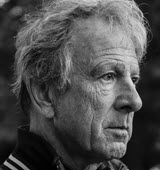
Robert Witmer has lived in Japan for the past 48 years. His poems and prose have appeared in many print and online journals. He has also published three books of poetry: Finding a Way, Serendipity, and Sunrise, in a Rabbit Hole.