What the Algorithm Gave Me, and What It Took
The app that introduced me to the man I loved was not Instagram. It was not Tinder nor LinkedIn nor any of the platforms that data-harvest your attention and sell it in slices to people who want to sell you things. It was a letter app, an almost willfully obscure service that slowed everything down on purpose, held your messages for hours before delivering them, and asked you to write instead of scroll. I tell people this, and they find it romantic. I find it complicated. Because the love was real, and so was the app, and I am not sure I get to have one without the other.
Darío lived in a pueblo in Granada. I lived in Barcelona, which is a city that has been so thoroughly consumed by platforms—by Airbnb, by Instagram tourism, by the logic of the feed—that large parts of it no longer belong to the people who grew up there. We fell in love through letters. We eventually tried to build a life together in his village, in an olive grove, away from all of it. I could not adapt.
This is the thing nobody says cleanly in the conversation about digital detox and extractive tech: most of us are not outside the machine looking in. We are inside it, and we got here because the machine gave us something we actually wanted. Connection. Community. Love, sometimes. The question of how to stop is not purely a question of willpower or ethics. It is a question of what you are willing to lose.
I have read the arguments. I have read about attention economies and surveillance capitalism and the documented evidence that these platforms are designed, with intention and precision, to be impossible to leave. I believe all of it. I also used an app to meet the most important person of my adult life, and I do not know how to hold both of those things except awkwardly, in both hands, like something fragile and slightly too large.
There is a version of the digital disconnection essay that I cannot write. It is the one where the author moves to a cabin, deletes their accounts, and discovers silence and self and the natural world. I tried something adjacent to that—not a cabin, but a pueblo, not silence chosen but silence arrived at by circumstance—and what I discovered was that I am a person made by friction, by density, by the particular electricity of a city that puts strangers in constant proximity. I missed Barcelona every day. I also missed, and this embarrasses me more, the feed. The scroll. The low-grade sense of being plugged into something larger than the view from a kitchen window, however beautiful that view was.
What does it mean that I missed the feed? I have spent time with this question and I think the honest answer is not flattering. The feed gave me the feeling of presence without the cost of presence. It let me be a citizen of a world I was not physically in. It is a simulation of connection—everyone who has written about this is correct—but simulations work on us. They trigger the same receptors. The brain does not fully distinguish between the warmth of a friend’s face across a table and the warmth of a notification that someone, somewhere, acknowledged you. One is real and one is a product. Both register as relief.
The beast is extractive because it understood, before we did, that loneliness is the condition and connection is the cure and it could manufacture something close enough to the cure to keep us coming back without ever quite resolving the loneliness. Every platform optimizes for return visits. Return visits require that the last visit left something unfinished, some itch unscratched, some question unanswered. Satisfaction would be bad for business. You are not a user. You are a gap that is never allowed to close, a patient whose condition must be managed indefinitely, never cured.
And yet I keep the accounts. I keep the apps. I have done the thing where you delete them from your phone and reinstall them three days later, which is perhaps the defining gesture of our particular historical moment—the dramatic exit, the quiet return, the pretense that this time you will use it differently. I have done the digital sabbath, the screen time limits, the grayscale phone trick. I have been in conversations with other people doing the same things, comparing strategies like prisoners comparing escape plans, and there is something almost comforting about that, the shared absurdity of it, which I have experienced mostly online.
What I keep coming back to is the letter app. Not as a solution—it was, in the end, a product too, with a business model, running on servers owned by someone—but as a form that asked something different of me. It asked for slowness. For consideration. For the kind of communication that has a shape, a beginning and a middle and an end, rather than the endless present-tense of the scroll. The love I found there was real partly because the form demanded reality. You cannot perform a letter the way you can perform a post. A letter goes somewhere specific. It is addressed. It expects a reply. It makes you, briefly, accountable to another person rather than to an algorithm.
I think about this when people ask what the alternative looks like. Not deletion—I don’t believe in it, not for most of us, not when the platforms are also where the organizing happens, the community happens, where people find each other across distances that used to be insurmountable. The alternative might be smaller and less dramatic than we want it to be. It might be a matter of form: choosing, when you can, the modes that require more of you. Writing the email instead of leaving the comment. Making the call instead of sending the reaction. Not because these gestures will trouble the algorithm, which will not notice your absence and will not be hurt by your silence, but because they change what you get back. They return something human-shaped rather than engagement-shaped.
Darío and I are not together. I am in Barcelona, which is increasingly a city in a photograph of itself, and he is in Granada, in the olive groves, with an internet connection he uses less than I do and a relationship to silence that I admired from a distance and could not, up close, sustain. The app that brought us together also, in a way, set us up for a specific kind of heartbreak—the kind where you fall in love with a version of a person and a life that was assembled under ideal conditions, in a form that forgave everything and rushed nothing, and then discover that actual life is less generous.
But I don’t want to end there, with the warning, with the it-was-just-a-simulation. It was not a simulation. I loved him. I love him still, in the past tense that love takes on when it has nowhere to go. What the letter app gave us was real, even if the conditions that produced it were artificial, even if the company that ran it had a privacy policy I did not read and investors whose interests were not mine. Purity is not available. The beast is large and we are inside it and most of the things we value—connection, recognition, the feeling of being known—have become, at least partly, its products.
What I want, and what I think most people want when they talk about starving the beast, is not escape. It is negotiation. Some way of staying inside the machine without being entirely consumed by it. Some form that asks more of us than a tap, a swipe, a reaction. Some reminder, daily if possible, that there are people on the other end of these wires—not audiences, not engagement metrics, not the ambient presence of the feed—but actual people, sitting somewhere, waiting twenty-four hours to hear back.
I keep trying to follow a quiet rule: to use these spaces without mistaking them for the thing itself. Yet a shadow of doubt still crawls along the back of my mind. These platforms are a method, a temporary arrangement, a tool for crossing whatever distance exists, but I feel a growing need to keep the crossing mine alone. Social media cannot and must not live my life for me.
The temptation remains. To surrender a little control. To let the machine shoulder the burden of my choices. I will probably always be an addict, and my goal is not to be cured, only to maintain some fragile measure of control over the addiction.
Will that be enough to keep the machinery at bay? Whether I ultimately become its fuel or escape its gears remains to be seen. Only time—and push notifications—will tell.


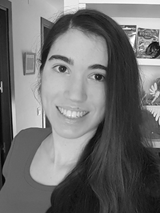
With a degree in economics and Japanese, Diana Parrilla writes fiction published by Inkd Publishing, Blue Planet Press, Murderous Ink Press, and others. She was awarded first prize in the 2024 Mollie Savage Sci-Fi & Fantasy Contest and received an Honorable Mention in the 2025 Writers of the Future Contest.